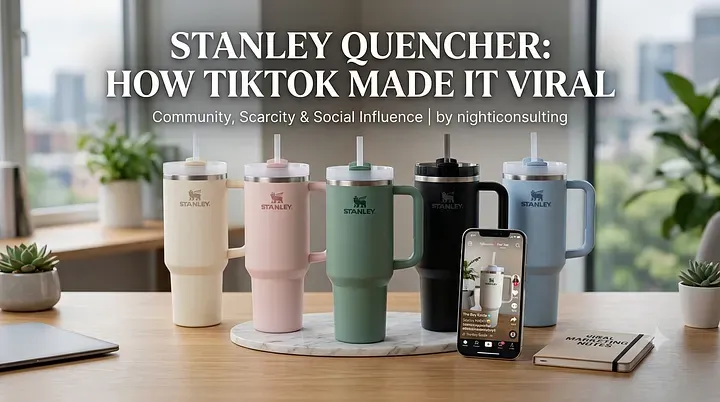
Imagine going back to 1994 and asking people what a highly desirable product of the 2020s would look like. A large reusable tumbler with a handle, straw and dozens of colors probably would not have been the first answer. Yet the Stanley Quencher became exactly that: a drinkware product that moved from a useful item to a major part of online culture.
The story behind Stanley is not simply about a water bottle becoming popular. It is a case study in how an established brand can use creators, community, product design and social media influence to reach a completely new audience. Stanley’s annual sales rose from about $73 million in 2019 to roughly $750 million in 2023, with the Quencher playing a major role in that growth.
The most important part of the story is that the Quencher was not an overnight product invention. Stanley introduced the tumbler in 2016, but it initially received limited attention. Its growth accelerated after the product was discovered and promoted by The Buy Guide, a women-led shopping platform, which helped introduce the Quencher to a new group of consumers. Stanley then expanded the product through new colors, finishes and social-media-focused marketing.
That change shows an important rule of modern product marketing: sometimes the product does not need to change dramatically; the meaning around the product does.
For much of its history, Stanley was strongly associated with durable bottles and thermoses used by outdoor workers, travelers and people who valued function over fashion. The Quencher allowed the company to move into a different part of the market. Its large size, handle, straw, cup-holder-friendly shape and wide range of colors made it useful, but also made it easy to show online.
That visual quality became important because social platforms reward products that can become part of everyday content. Users began showing their collections, matching colors with outfits, decorating their tumblers and sharing accessories. The product was no longer simply something used to carry water. It became something people could display and personalize.
This is where the Creator Economy changed the business equation for Stanley. Instead of depending only on traditional advertising, the brand benefited from customers and creators producing their own content. The message could travel through many different communities at the same time, with each creator giving the product a slightly different meaning.
Terence Reilly, who became Stanley’s president in 2020 after serving as a senior marketing executive at Crocs, became closely associated with this change in strategy. Reilly has discussed the idea of brands working with consumers and creators rather than treating marketing as a one-way message. His previous experience at Crocs also gave him experience in turning a functional product into a stronger lifestyle brand.
One of the clearest examples came when a TikTok video showed a Stanley tumbler inside a car that had caught fire while the cup still contained ice. Stanley responded by offering the woman replacement support, including a new car. The moment became a major piece of organic brand exposure because the company turned an unexpected customer story into a public demonstration of the product’s durability and its relationship with consumers.
The lesson is bigger than that single viral video. A traditional advertisement tells people what a product can do. A customer story can show them.
Stanley’s growth also demonstrates the business value of scarcity. Limited colors, collaborations and special releases created additional reasons for consumers to pay attention. Some launches generated intense demand and long lines, showing how limited supply can turn an ordinary product release into an event. Creator content then gave those releases another distribution channel beyond the company’s own advertising.
This combination creates a powerful growth loop. A product becomes visible on social media, consumers become curious, creators make more content, new buyers join the community, and those buyers create more content of their own. The brand receives attention without needing to personally produce every piece of media.
That is the deeper reason the Stanley case matters to businesses. The company did not simply sell more tumblers. It built a form of social identity around the product.
For consumers, this can be seen in the way a Stanley became part of personal style and online identity. For creators, the product provided an easy subject for videos, collections, reviews, accessories and lifestyle content. For Stanley, every customer-created post could introduce the product to another potential customer.
The same model is now visible across the wider Creator Economy. Products that are easy to demonstrate, customize, collect or compare can become natural content subjects. A strong product can therefore act as its own marketing material when customers have a reason to talk about it.
However, viral growth also creates challenges. Stanley faced criticism and online discussion around safety concerns involving lead-containing material used in the manufacturing process. The company said the material was sealed within the product and covered by stainless steel. Separately, legal claims and public discussion have raised concerns about possible exposure if the product is damaged. These claims should be treated carefully, and consumers should rely on current company statements, product guidance and relevant regulatory or legal information rather than social-media posts alone.
The brand also faced criticism surrounding aggressive demand for limited releases. Such moments demonstrate an important risk of viral marketing: when demand becomes part of the story, the excitement can also produce negative attention. A business therefore needs a plan for customer service, product availability, safety communication and reputation management before a campaign takes off.
There is another important lesson in Stanley’s timeline. Viral success did not come simply because someone posted a video on TikTok. The company had already spent decades building a reputation around product quality and durability. The Quencher gave that existing brand equity a new cultural context.
For newer businesses, this distinction matters. Copying Stanley’s colors, influencer strategy or limited-edition launches will not automatically create the same result. The more useful question is what existing customer behavior can be turned into a community, conversation or cultural signal.
A local business can apply the same thinking on a smaller scale. A restaurant could encourage customers to share a signature dish. A clothing brand could let customers personalize products. A fitness company could build challenges around its members. A small consumer brand could work with a few trusted creators whose audiences closely match its target customers instead of paying for broad advertising.
The goal is not simply to become viral. The goal is to create a product and customer experience that gives people a reason to share.
Stanley’s story also shows why Brand Endorsements and Social Media Influence work differently from traditional advertising. A paid advertisement tells consumers that a brand wants their attention. A customer post can suggest that another person already found value in the product. That difference can make peer recommendations powerful, although creator relationships and sponsored content still need to be clearly disclosed where required.
The wider Business Strategy lesson is therefore straightforward: cultural relevance can expand the value of a functional product. Stanley did not abandon the utility that made its products useful. It added design, community, creator participation, scarcity and a new audience around that foundation.
The brand’s rapid rise also shows why businesses should not confuse viral attention with permanent demand. By 2024 and 2025, industry coverage was already discussing whether the wider reusable-bottle trend was cooling, while Stanley continued looking for new categories and products beyond the Quencher.
That transition is important because every viral product eventually faces the same question: what comes next?
For Stanley, the answer has increasingly involved expanding beyond the original tumbler while trying to protect the brand’s identity. That makes the company’s journey useful for both established brands and startups. A viral product can create customer awareness quickly, but long-term Brand Value depends on product quality, repeat demand, customer trust and the ability to keep the brand relevant after the initial trend fades.
The Stanley Quencher is therefore more than a successful water bottle. It is an example of how an established product can gain a new life when a company combines product utility with creator marketing, community, cultural relevance and smart distribution.
The biggest takeaway for modern marketers is simple: people do not always share products because they are new. They share products because those products give them something to say, show, collect or identify with. Stanley understood that shift and turned a functional drinkware product into a social-media-driven lifestyle brand.