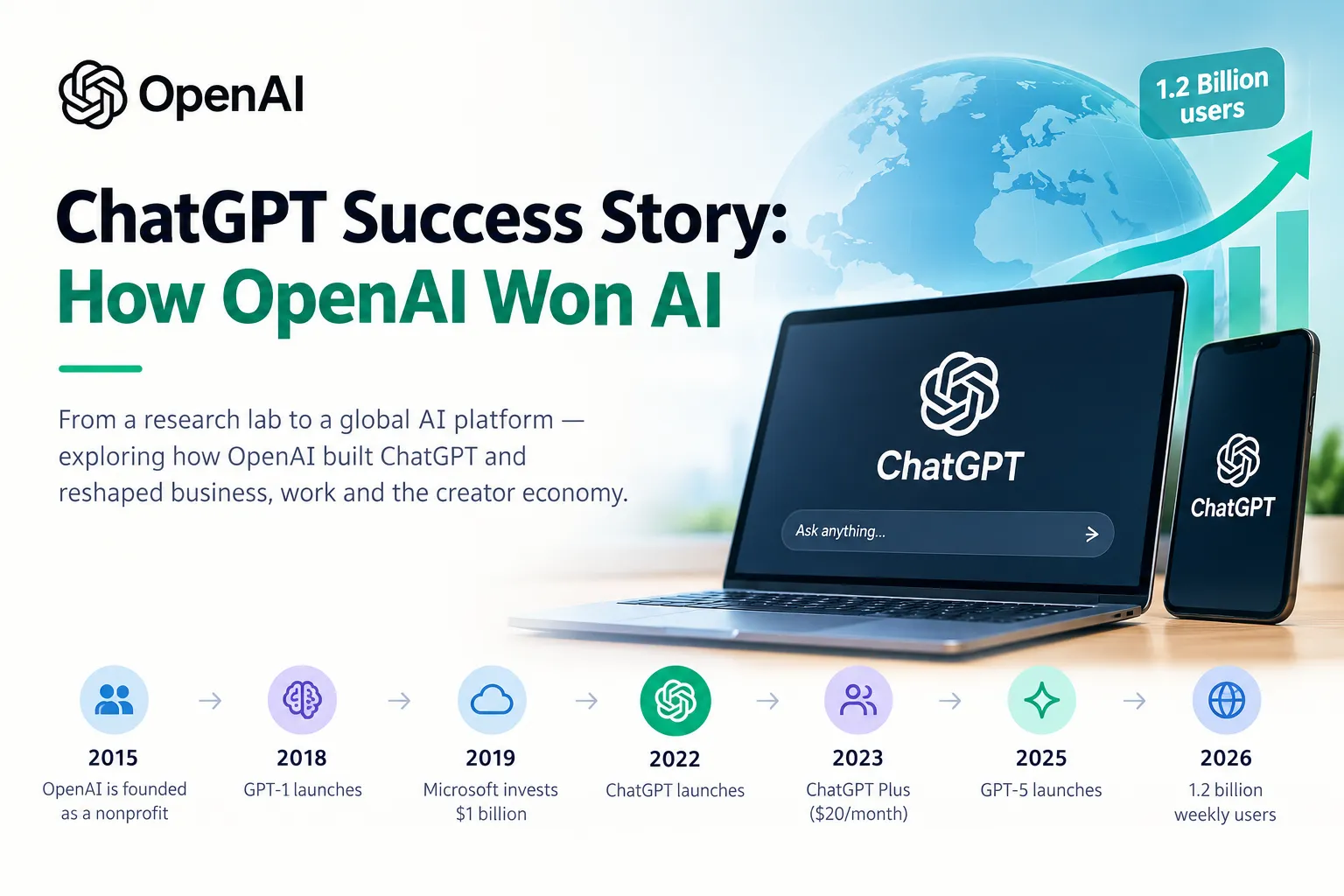
ChatGPT has moved from being a simple AI chatbot to one of the most widely used consumer technology products in the world. OpenAI says ChatGPT was already being used by nearly 700 million people every week when GPT-5 launched in August 2025, while later reporting in September 2026 put ChatGPT consumer users at about 1.2 billion. That growth raises a much bigger question than simply how an AI chatbot became popular: how did OpenAI build a product that changed the way people learn, work, create content and use software?
The story starts in December 2015, when OpenAI was launched as a nonprofit AI research company. Its original mission was to make advanced AI benefit humanity rather than be controlled only by a small group of companies. The founding group included Sam Altman, Elon Musk, Greg Brockman, Ilya Sutskever and several other researchers and technology leaders. OpenAI announced that its early backers had committed a combined $1 billion, although that figure was a commitment rather than money immediately sitting in the company’s bank account.
At that stage, OpenAI was not a consumer technology company. It was a research organization working on areas such as reinforcement learning, robotics and machine learning. Its early projects helped researchers experiment with AI systems, but there was still no mass-market product that made advanced AI feel simple enough for an ordinary person to use.
That began to change with the GPT series. GPT-1, introduced in 2018, showed that large language models could learn patterns from large amounts of text and use those patterns to generate language. GPT-2 pushed the idea further, while GPT-3 demonstrated how much more capable these systems could become when training data, model size and computing power were increased.
But there was a major business problem behind this progress: frontier AI required enormous computing resources. OpenAI later explained that it had underestimated how much computing power would be needed to build increasingly advanced systems. That pressure helped drive the company’s move toward a commercial structure. In 2019, OpenAI created a for-profit subsidiary while keeping the nonprofit in control.
Microsoft then became a critical partner. In July 2019, Microsoft announced a $1 billion investment in OpenAI and agreed to provide large-scale Azure computing infrastructure. The partnership gave OpenAI access to the computing resources needed to train increasingly large AI models, while Microsoft gained a close relationship with one of the fastest-moving AI research companies.
This is an important part of the ChatGPT success story because AI progress is not only about having a good algorithm. It also depends on computing power, data, research talent, infrastructure and enough capital to keep improving the system. OpenAI’s business strategy increasingly combined all of those pieces.
The next major step came with GPT-3 and then GPT-3.5. OpenAI had powerful language technology, but most ordinary people still needed technical knowledge to work with these models. The breakthrough was therefore not simply another larger model. It was turning the technology into a product that people could use through a normal conversation.
On November 30, 2022, OpenAI released ChatGPT as a research preview. The response was extraordinary. OpenAI later reported that ChatGPT reached 1 million users within five days and 100 million users within two months.
The product strategy was simple but powerful. Users did not need programming skills, special software or knowledge of machine learning. They could simply type a question and receive an answer. That low barrier to entry allowed students, programmers, writers, marketers, business owners and ordinary consumers to discover different uses for the same product.
This versatility became one of ChatGPT’s strongest advantages. A student could use it for learning, a developer could use it for debugging, a business could use it for drafting documents, and a creator could use it for brainstorming. Instead of selling one narrow AI function, OpenAI created a general-purpose interface that allowed users to decide what the technology was useful for.
The free product also created a powerful growth loop. People could try ChatGPT without making an immediate purchase, discover a useful application and then share their experience with others. Screenshots and demonstrations spread across social platforms, creating additional attention without OpenAI having to rely only on traditional advertising.
That growth eventually became a business opportunity. In February 2023, OpenAI introduced ChatGPT Plus at $20 per month, offering priority access and faster responses. A month later, GPT-4 arrived on ChatGPT Plus, bringing stronger reasoning and multimodal capabilities. This created an important business model: keep a free product available to drive mass adoption while charging professional users for greater access and more advanced capabilities.
The strategy also expanded beyond text. In 2023, OpenAI added features such as web browsing, voice and image capabilities, while DALL-E 3 was integrated into ChatGPT Plus and Enterprise. This changed the product from a text chatbot into a broader AI platform.
However, rapid growth also exposed serious weaknesses. One of the most important technical problems was hallucination, where an AI system can produce incorrect information in a confident and convincing way. OpenAI itself has acknowledged hallucinations and social bias as known limitations of its models. For businesses, this created an important lesson: AI output can save time, but important information still needs human review.
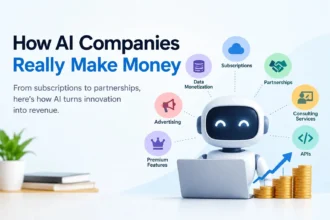
The financial side was also challenging. Operating large AI models requires expensive computing infrastructure, and millions or billions of interactions can create significant costs. OpenAI therefore had to balance rapid user growth with a sustainable business model. Its subscription plans, enterprise products and API business became important parts of that strategy.
Then came one of the most dramatic episodes in the company’s history. In November 2023, Sam Altman was removed as OpenAI’s CEO by the company’s board. Greg Brockman also stepped down from the board. The decision triggered intense pressure from employees and investors, and Altman returned only days later after major changes to the board. The episode showed that OpenAI was no longer simply an AI research project; decisions inside the company could affect employees, investors, technology partners and the wider AI market.
Competition also accelerated. Google launched Bard, later renamed Gemini, while Elon Musk’s xAI introduced Grok. In January 2025, DeepSeek became another major competitor after its AI assistant rapidly climbed Apple’s U.S. App Store rankings and attracted global attention for its claims around performance and lower-cost development.
That competition matters because ChatGPT’s position cannot be understood only through user numbers. The AI market is changing quickly, with companies competing on model quality, price, speed, computing efficiency, integrations and access to real-time information. A strong competitor does not necessarily need to replace ChatGPT entirely; it can force OpenAI to improve its product, lower costs or introduce new features.
OpenAI responded by continuing to increase the capabilities of its models. GPT-5 was introduced in August 2025 with stronger reasoning, coding, writing and multimodal abilities. By 2026, OpenAI had moved beyond GPT-5, with the company and reporting referring to newer GPT-6-generation systems and increasingly autonomous AI products. This means the original ChatGPT story is no longer only about a chatbot. It has become a story about the race to build AI systems that can perform increasingly complex tasks.
The Creator Economy has been one of the biggest areas affected. Writers, YouTubers, marketers, designers and small businesses can now use AI for research, brainstorming, drafts, customer communication and content planning. That does not automatically replace human creativity. Instead, it changes where human effort is spent. People who use AI effectively can reduce time spent on repetitive work and focus more on ideas, decisions and final quality.
Businesses have also had to rethink their strategy. AI is becoming part of customer support, software development, research, marketing and internal workflows. OpenAI reported in 2025 that more than half a billion people were using its AI tools and that its systems were processing more than 2.5 billion messages per day at that time. The scale shows why AI is becoming a business issue rather than simply a technology trend.
At the same time, the risks cannot be ignored. Concerns about misinformation, privacy, bias, over-reliance on AI and the effect of conversational systems on vulnerable users have become part of the wider AI safety debate. These issues are especially important when children or people in emotional distress use AI systems without adult or professional support.
One case that has received significant legal and public attention involves Adam Raine, a 16-year-old California teenager who died by suicide in April 2025. His parents later sued OpenAI, alleging that ChatGPT contributed to his death and provided harmful assistance. Those are allegations made in litigation, not established findings that ChatGPT caused his death. Reporting on the case describes the family’s claims, while the legal process and evidence remain important to understanding what ultimately happened.
That distinction matters. Claims about AI-related deaths are extremely serious, but they should not be presented as proven causal facts unless a court or reliable evidence establishes them. For users, the practical lesson is clear: AI should not be treated as a replacement for parents, teachers, doctors, mental-health professionals or emergency services, particularly in situations involving self-harm or other immediate danger.
As observed in the latest OpenAI updates, the company’s challenge has therefore changed. The first challenge was proving that people wanted conversational AI. The next was making the technology commercially sustainable. Today, the larger challenge is building AI that can become more capable while remaining reliable, safe and useful at massive scale.
The ChatGPT story also shows why brand value in technology can grow through product habit rather than traditional advertising alone. Once millions of people use a service for work, education and everyday tasks, the product can become part of their normal digital routine. That creates a strong form of social media influence and customer loyalty, but it also raises expectations. Users increasingly expect AI products to be accurate, fast, available and safe.
For ordinary users, the most useful takeaway is not simply that ChatGPT became successful. It is that AI is moving from being a separate tool to becoming part of everyday software. People can benefit from it for research, learning, writing, coding and business tasks, but important information should still be checked against reliable sources, especially when the decision involves money, health, education, law or safety.
From a business strategy perspective, OpenAI’s journey shows that successful technology products often need more than advanced technology. They need simple user experience, strong infrastructure, a clear business model, constant product improvement and the ability to respond quickly when competitors enter the market. ChatGPT combined those factors at a moment when the public was ready to experiment with generative AI.
The story is therefore still being written. ChatGPT helped turn generative AI from a technology discussed mainly by researchers into a mainstream consumer product. OpenAI’s growth has created new opportunities across the Creator Economy, software, education and business, while also creating difficult questions about safety, trust and responsible AI use. Based on the latest public updates, the most important part of the ChatGPT success story may no longer be how quickly it reached billions of users, but how effectively the AI industry can turn that scale into useful technology without losing reliability and human oversight.
SOURCE: NightiConsulting