NVIDIA CEO Jensen Huang sees the next phase of technology as much bigger than faster computers or better AI tools. His vision is built around a simple idea: computing is moving from systems that mainly follow instructions to systems that can learn, reason and eventually interact with the physical world.
In a detailed conversation about the future of technology, Huang explained how NVIDIA’s work on GPUs, CUDA and AI helped create the foundation for today’s computing shift. He also outlined where he believes the next major opportunities could come from, including robotics, digital biology, climate science and AI-powered personal assistants.
Huang’s view of the future starts with a decision NVIDIA made decades ago. Instead of relying only on traditional CPUs that process many tasks sequentially, the company focused on parallel computing through GPUs. This approach was first driven by the demands of video games, where large numbers of calculations need to happen at the same time to create detailed digital worlds.
That decision later became important far beyond gaming. NVIDIA developed CUDA, a platform that allowed developers and researchers to use GPUs for general computing rather than treating them only as graphics processors. According to Huang, this created a much larger opportunity for researchers to use parallel computing across different fields.
The importance of that strategy became clearer in 2012, when the AlexNet neural network achieved a major improvement in image recognition using NVIDIA GPUs. For Huang, the bigger question was not simply how well that particular system worked, but how far the underlying approach could scale.
That belief led NVIDIA to make large, long-term investments in AI computing. Huang described the company’s approach as staying committed to its core beliefs even when the results were not immediately visible. NVIDIA eventually moved toward redesigning the computing stack around AI, helping position GPUs as a key part of modern artificial intelligence infrastructure.
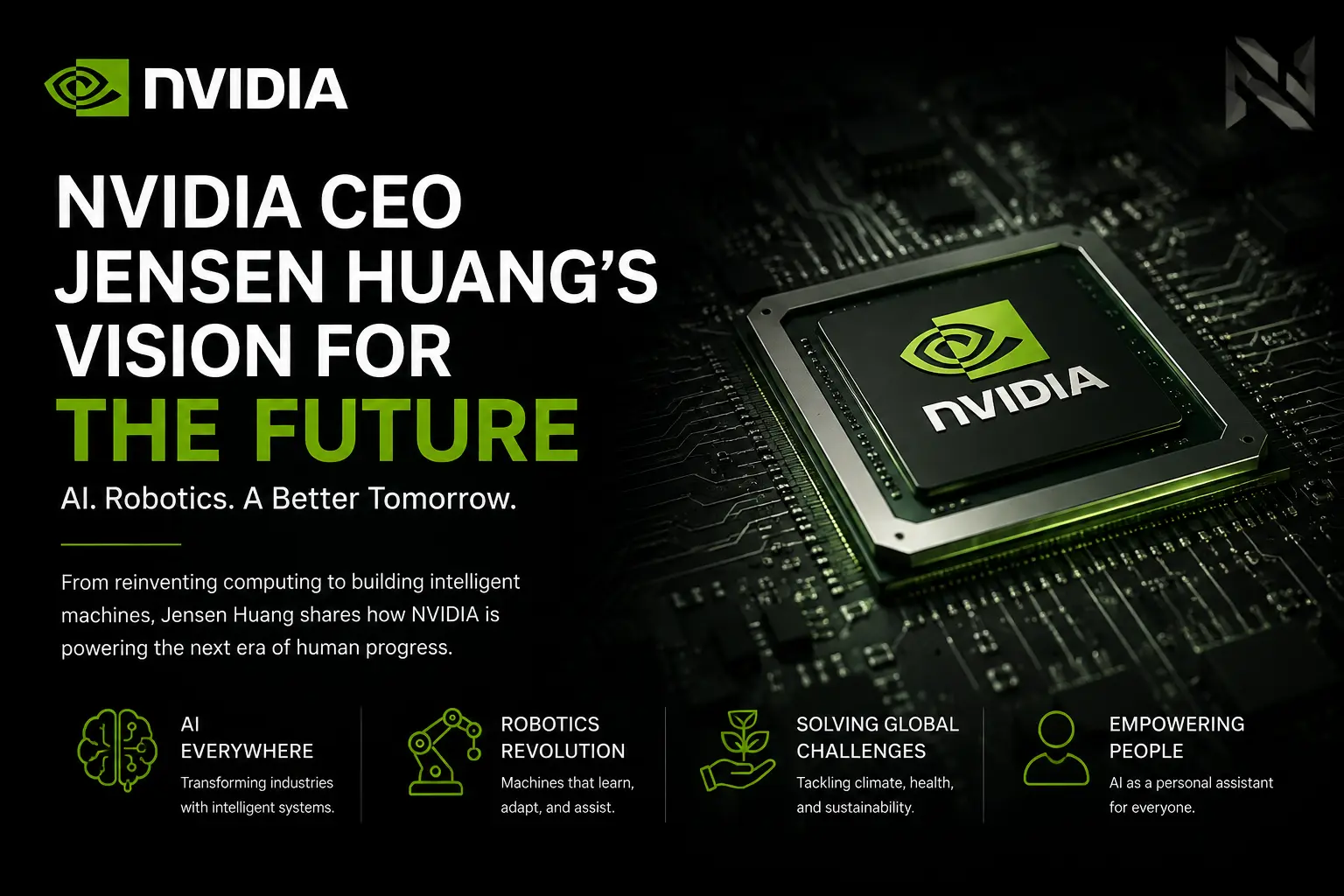
This history is important because Huang does not view AI as a single product category. He sees it as a new computing platform that could eventually affect almost every major industry. The next phase, in his view, will move from the basic science of AI toward the application of AI in areas such as agriculture, logistics, transportation, education, digital biology and climate science.
That shift could have a direct effect on the broader business landscape. If AI reduces the time required to complete complex work, companies may be able to develop products faster, analyze more information and automate tasks that previously required large teams. The Creator Economy could also benefit as individuals gain access to AI tools for writing, programming, research, design and content production.
Huang’s strongest prediction, however, is about the physical world. He expects robotics to become much more common, including humanoid robots, autonomous vehicles, warehouse systems and other machines that can operate with less human control. He argued that eventually, many things that move could become robotic.
A major part of NVIDIA’s strategy for this future involves teaching robots inside digital environments before they operate in the real world. Huang discussed the combination of Omniverse and Cosmos, where simulated environments can provide robots with large numbers of training situations without requiring every experiment to happen physically.
The business value of this approach could be significant. Physical testing can be slow, expensive and risky. Digital simulation can allow developers to test different lighting conditions, routes, obstacles and physical situations repeatedly. If these systems become reliable, robotics companies could potentially reduce development time while giving machines more experience before deployment.
This is also where NVIDIA’s broader brand value becomes important. The company’s influence is no longer limited to gaming hardware. Its technology is increasingly connected to AI infrastructure, robotics, scientific research and other high-value technology markets. That creates opportunities for NVIDIA while also making the company’s strategic decisions more important to the wider technology industry.
Huang also sees AI becoming a personal productivity tool rather than something used only by large technology companies. He encouraged students and professionals to learn how to work with AI and ask how these systems can make them better at their existing jobs.
For an individual, the practical lesson is relatively simple. AI does not necessarily mean that every profession disappears. Instead, people may increasingly work alongside systems that can handle research, analysis, coding, writing and other tasks. The advantage could go to people who understand how to use these systems effectively while bringing human judgment, creativity and responsibility to the work.
The same idea could change Social Media Influence and the Creator Economy. A creator with access to powerful AI tools may be able to research topics, produce drafts, analyze audiences and build content much faster than before. At the same time, this could increase competition because more people will have access to similar capabilities. Original ideas, trust, expertise and strong personal brands may therefore become even more important.
There are also clear risks. Huang acknowledged concerns around bias, misinformation, impersonation, AI hallucinations and failures in systems such as autonomous vehicles. His comments suggest that AI safety cannot depend on one layer of protection. It requires reliable engineering, testing, security systems and backup mechanisms, particularly when AI moves from digital services into the physical world.
Energy is another major issue. More capable AI systems require significant computing power, making energy efficiency a key part of the industry’s future. Huang pointed to improvements in computing efficiency as an important factor in making increasingly powerful AI systems practical at scale.
Perhaps the most important part of Huang’s vision is that he does not believe today’s AI architecture represents the final stage of computing. He expects new AI methods and architectures to emerge over time. That belief explains why NVIDIA continues to favor flexible computing systems rather than building hardware around the assumption that today’s dominant AI methods will remain unchanged forever.
For businesses, this creates an important strategic lesson: technology investments should be designed with future change in mind. Companies that build systems capable of adapting to new AI models, automation tools and data methods may be better positioned than those that depend heavily on one technology trend.
For consumers, the change could be even more personal. Huang described a future in which people could have AI assistants that remain available across devices such as phones, computers, cars and wearable technology. His broader argument is that AI could act as a form of personal intelligence that helps people learn, create and solve problems more effectively.
The long-term impact on Brand Endorsements, business strategy and technology companies could therefore extend well beyond NVIDIA’s current products. If AI becomes part of everyday work and physical infrastructure, companies controlling the chips, software platforms and ecosystems behind these systems could hold an important position in the next phase of the digital economy.
Huang’s vision is ambitious, and many of the predictions about the timing and scale of these changes remain uncertain. Robotics, autonomous systems and advanced AI still face major technical, safety and economic challenges. The interview provides Huang’s perspective on where the industry could go, rather than proof that every prediction will happen exactly as described.
For readers and professionals, the most useful takeaway is to watch the shift from AI as a software tool toward AI as infrastructure for the physical and digital economy. The next stage could involve not only smarter chatbots, but machines that learn in simulated environments, scientific systems that model complex biological processes and AI assistants that become part of everyday work.
Ultimately, Jensen Huang’s vision is based on a long-running NVIDIA strategy: build more powerful and flexible computing systems, make them accessible to developers and researchers, and allow new applications to emerge. If that strategy continues to work, the biggest impact of NVIDIA may not be any single chip or product, but the role its technology plays in changing how people build, work and interact with machines.
Source: Independent monitoring of publicly accessible digital platforms. The analysis above is based on the supplied interview material and reflects Jensen Huang’s views expressed in that conversation. For future product, technical or deployment claims, readers should wait for official announcements and verified company information.