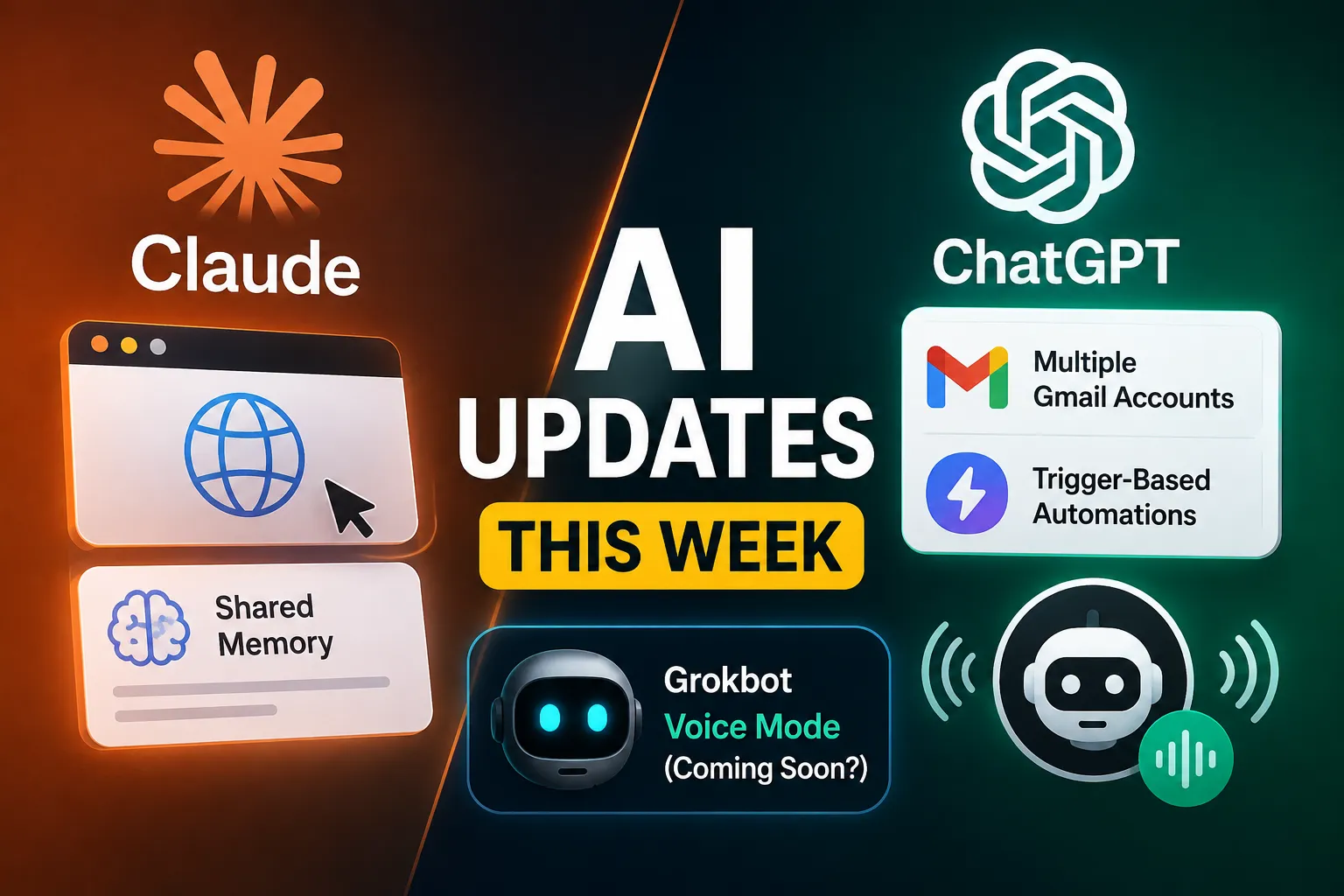
Claude and ChatGPT are both adding features that move AI assistants beyond simple chat. Based on the latest updates covered in the provided source, Claude is expanding its workflow tools with shared memory and a built-in browser, while ChatGPT is adding multiple Gmail accounts and trigger-based automations. The source also points to a possible voice feature for Grokbot, although that part remains unconfirmed.
One of the more useful Claude updates is the built-in browser inside Claude Cowork. Instead of depending on a Chrome extension and the user’s existing browser, Cowork can now open a browser in its own side panel, visit websites, read pages, click links and enter information when a task requires web access. This makes the workflow more direct because users can hand over web-based tasks without having to keep Claude connected to their normal browsing session.
The change matters because AI agents are increasingly being judged by how much work they can complete, rather than simply how well they answer questions. A built-in browser gives Cowork another layer of practical capability. For example, a user could ask it to check information on a website, collect data and use that information as part of a larger task. The source also shows that the browser can remain accessible through the mobile experience while the desktop application stays open and online, giving users more flexibility when working remotely.
Privacy and access controls are also important here. The reported setup allows users to choose which websites can carry over sign-in access rather than automatically giving the AI access to every connected website. That makes account permissions an important part of using browser-based AI agents safely. Users should only connect services that are actually required for the task.
Claude is also bringing memory closer together across Cowork and chat. According to the source, users can have one shared memory system across the two experiences, view saved information, edit it and delete memories they no longer want stored. This removes one of the common problems with AI assistants: having to repeatedly explain the same preferences and background information in different modes.
From a business strategy point of view, persistent memory can make AI tools more useful for repeat work. A consultant, marketer, creator or business owner may have recurring preferences, projects and workflows. If an assistant can remember useful non-sensitive context, users can spend less time giving instructions and more time reviewing the actual output. At the same time, memory needs to be managed carefully because users should understand what information is being retained and remove anything they do not want stored.
Another important development is the wider use of external app connections. The source describes Zapier MCP as a way to connect AI agents with thousands of applications beyond their native integrations. This could expand the Creator Economy and business use of AI because an agent does not have to remain limited to the small number of services directly supported by its platform.
ChatGPT is also expanding its email workflow. The reported update allows users to connect multiple Gmail accounts through one Gmail integration. That could be especially useful for people managing separate personal, business or project inboxes. Instead of switching between accounts manually, an AI assistant can potentially help organize messages, identify important emails and support email-based workflows across connected accounts.
The bigger development, however, is trigger-based automation in ChatGPT. The source describes a system where an event inside an application can start an AI task. One example is a new Gmail message that appears to be a sponsorship inquiry triggering an automated summary in a Slack channel. Other examples include drafting replies when a client sends an email, summarizing Slack conversations and reviewing GitHub pull requests.
This is an important shift in Business Strategy because it changes AI from a tool that people open when they need help into a system that can respond to events automatically. For businesses, the value may come from reducing repetitive work such as sorting emails, preparing summaries and moving information between applications. However, automation should still have clear rules and human review for sensitive business decisions, customer communication and actions that could create financial or reputational risk.
The reported trigger system is currently described as working with Gmail, Slack and GitHub, while access to the feature is available through the web and mobile experiences rather than the desktop application. That means users should check their own account and plan availability before building workflows around it, as feature access can change during a rollout.
The source also mentions a possible voice feature for Grokbot. A leaked screenshot reportedly showed a headphone-style button that could allow users to start voice conversations with AI agents. This is not presented as an official release, so it should not be treated as a confirmed product feature. If such a system is launched, however, voice could become another important interface for AI agents, particularly when users want to delegate tasks without typing detailed instructions.
The wider trend is clear: AI companies are competing not only on model intelligence but also on memory, browser access, app integrations, automation and natural interfaces such as voice. These features can increase Brand Value because an AI platform becomes harder to replace when it is connected to the user’s daily work. They can also increase Social Media Influence and creator productivity by reducing the time required for repetitive tasks.
For normal users, the practical lesson is to focus less on flashy AI demos and more on whether a feature can remove a real daily task. Shared memory can reduce repeated instructions. Browser agents can handle website-based work. Gmail integrations can simplify inbox management. Trigger-based automations can move information between apps without constant manual effort. The strongest value will come when these features are reliable enough to fit into regular workflows.
As observed in the latest product activity covered by the source, the AI market is moving toward assistants that can remember context, access websites, connect to business applications and act when something happens. That is a bigger change than simply making chat responses better because it brings AI closer to an active workplace tool.
Overall, these updates show that the next stage of the AI industry is likely to focus on AI agents and automation rather than chat alone. Claude’s browser and shared memory, ChatGPT’s expanded Gmail and trigger-based workflows, and the reported possibility of voice-driven agents all point toward the same direction: AI assistants are becoming more connected to the tools people already use. Businesses, creators and everyday users who learn to apply these capabilities to repetitive work could gain more value from AI than those who use it only for basic questions and content generation.
Feature availability and product details may change as companies continue their rollouts. The Grokbot voice feature mentioned above is based on an unconfirmed leak and should not be treated as an official release until the company provides confirmation.
SOURCE: Ongoing tracking of platform updates and online commentary.