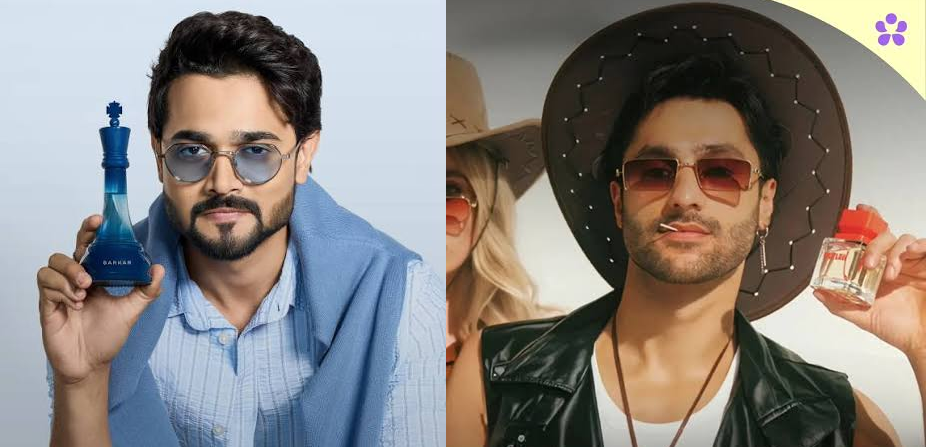
Bhuvan Bam and Harsh Beniwal are taking their creator businesses into a category that is becoming increasingly attractive to India’s new consumer brands: perfumes. Bam has launched SARKAR, a premium unisex fragrance brand, while Beniwal’s Octopus has built a range of 50 ml Eau de Parfum products, including fragrances officially described as inspired by well-known luxury scents.
The two launches are notable not simply because popular creators are selling perfumes, but because they show how India’s creator economy is moving from brand endorsements toward product ownership, business strategy and long-term consumer brands.
SARKAR was launched in August 2026 by Bhuvan Bam along with Neel Gogia, Rohit Raj and Jag Chima after nearly three years of development. Its initial collection includes four unisex fragrances — Orion, Noble, Throne and Regal. The brand positions itself between mass-market fragrances and higher-priced luxury products, with 100 ml bottles currently listed on its official store from around ₹1,399 to ₹2,499, depending on the fragrance.
One of SARKAR’s main product claims is its 25% perfume oil concentration. The brand presents the collection as parfum-level fragrances, with Orion, Noble and Throne formulated in France and Regal developed in Spain. SARKAR also says its fragrances are IFRA-compliant.
The positioning is important because the company is not presenting the products simply as merchandise connected to Bhuvan Bam. Its official brand messaging focuses on identity, premium fragrance and a standalone brand experience. That distinction matters in the creator economy: a creator can use personal reach to bring attention to a product, but a consumer company needs customers to remember and buy the brand itself, not only the person behind it.
Harsh Beniwal’s Octopus is taking a somewhat different route. The brand describes itself as a consumer company focused on quality products at prices designed for the Indian market. Its current fragrance catalogue includes 50 ml Eau de Parfum products such as Overlord, Your Move, Outlaw, Promised, Mirage and others.
Octopus is also more direct about fragrance inspiration. Its official store describes Overlord as inspired by Sauvage, Your Move as inspired by Oud Wood, Outlaw as inspired by Ombre Leather and Promised as inspired by BR540. Current listed prices across the range run from under ₹1,000 to around ₹1,900 for several products, although prices can change with offers.
The product details also show that Octopus is not following one fixed concentration across the entire range. For example, its official product pages list Overlord at 25% perfume concentration, Your Move at 25%, Outlaw at 29%, and some other fragrances at 35%.
Octopus says it works with established manufacturers and sources raw materials globally. Its official information identifies Vanesa Cosmetics Pvt Ltd. in Sonipat, Haryana, as the manufacturer and Octopus Lifestyle Pvt Ltd. as the marketer.
This difference between the two brands highlights an important change in creator-led business strategy. SARKAR is building a distinct premium fragrance identity around its own collection, while Octopus is using familiar fragrance profiles as part of its product proposition. Both approaches attempt to solve the same business problem: converting a creator’s existing social media influence into a consumer product that people can actually purchase.
Perfume is particularly suitable for this model. Unlike apparel, a fragrance brand does not need to manage dozens of sizes and colour combinations for every product. A small collection can cover different preferences while keeping the product range relatively simple. At the same time, fragrance has a strong connection with personal identity, making it suitable for storytelling, visual content and creator-led marketing.
This creates a useful business equation for creators: audience + personal brand + consumer product.
Traditional consumer brands often have to spend heavily on advertising and influencer marketing before they build awareness. A creator already has an audience that can provide an initial source of attention. That does not remove the normal challenges of running a consumer business, but it can reduce the distance between product launch and potential customers.
The important point, however, is that audience size alone cannot guarantee a successful consumer brand. A perfume business still has to deal with product quality, pricing, customer reviews, repeat purchases, distribution, returns, advertising costs and customer retention. The real test comes when customers purchase the product without needing a creator’s constant promotion.
That is also why packaging and brand identity matter so much in this category. Perfume is not only about the liquid inside the bottle. The bottle design, name, box, photography and unboxing experience all influence how consumers understand the product’s price and positioning.
SARKAR’s visual identity is built around its own brand language and four named fragrances, while Octopus uses distinctive product names and presentation to create a separate identity around its catalogue.
For the wider creator economy, this represents a shift in the way social media influence can create value. The earlier model was largely based on brand endorsements, where a creator promoted another company’s product in exchange for a fee. The newer model gives creators an opportunity to become co-founders, owners, investors or long-term business partners.
That difference can have a major effect on the economics of creator businesses. An endorsement usually provides campaign income. A consumer brand can potentially create a longer relationship with customers through repeat purchases, new products and wider distribution. At the same time, ownership also brings greater business risk because the creator becomes associated with the product’s performance and customer experience.
SARKAR and Octopus therefore represent two examples of the same broader movement: social media influence is increasingly being used as a starting point for consumer entrepreneurship.
For consumers, the practical lesson is also fairly simple. A creator’s involvement can help a new product gain attention, but it should not be treated as proof of product quality by itself. Buyers can look at fragrance notes, concentration, bottle size, ingredients and manufacturer information, compare pricing, and check independent customer feedback before purchasing. Concentration percentages also should not be treated as a guarantee of how long a perfume will last, because performance can vary with formulation, skin, weather and application.
As observed in the latest updates from both brands, the creator connection is central to their launch stories, but both companies are also working to establish identities that can operate as consumer brands. That distinction could become increasingly important as more Indian creators enter categories such as beauty, fashion, food, wellness and lifestyle.
The bigger business story is therefore not simply Bhuvan Bam launching SARKAR or Harsh Beniwal launching Octopus. It is the growing movement from creators being paid to promote products toward creators participating in the businesses behind those products. If this model continues to expand, creator-led companies could become a more visible part of India’s consumer market, where social media reach acts as an early distribution advantage while product quality and customer retention determine whether that attention turns into a lasting business.
Based on the latest publicly available brand information and platform updates, product details and prices can change over time. Readers should check the respective official brand pages for the latest specifications, availability and pricing before making a purchase.
SOURCE: NightiConsulting