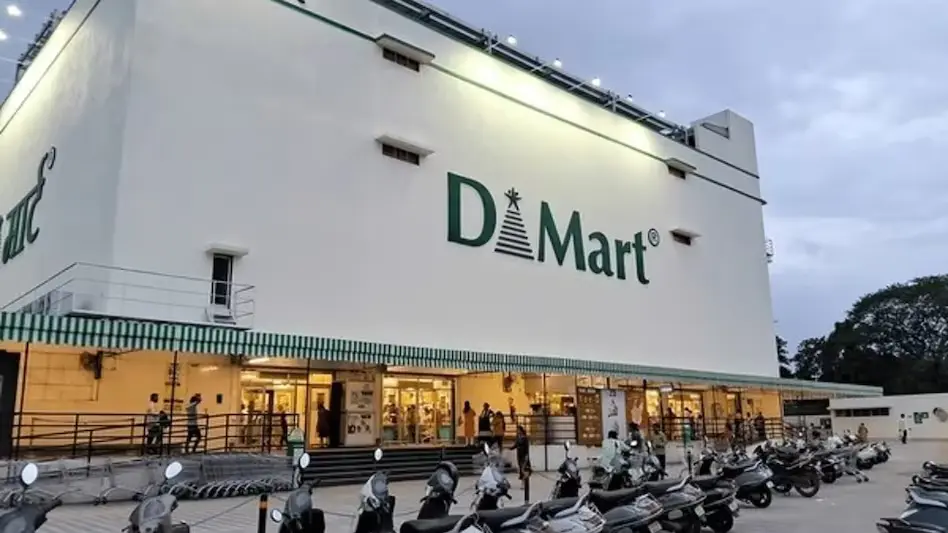
Go to any DMart store on a weekend and the scene can look like a sign of a business that is doing everything right. Billing lines are long, finding a trolley can be difficult, and parking can become a challenge. Yet the stock market is asking a very different question: if customers are still filling DMart stores, why has the growth story become a concern?
The answer became clearer after Avenue Supermarts, the company behind DMart, released its Q1 FY27 results on July 11, 2026. Standalone revenue rose 15.1% year-on-year to ₹18,343.5 crore, while consolidated revenue increased 15% to ₹18,794.5 crore. Standalone net profit also rose 12.8% to ₹935.8 crore. On the surface, these are healthy numbers. The concern is not that DMart stopped growing. It is that some of its most important growth indicators are slowing.
The biggest signal came from older stores. DMart reported 5.5% like-for-like growth for stores that were more than two years old, compared with 7.1% in the same quarter a year earlier and 10.8% in Q4 FY26. More importantly, management said growth in older stores in large metro markets was flat, while non-metro stores continued to perform well. This matters because mature stores have already had time to build their customer base and normally provide a strong measure of the health of the core retail business.
That makes the DMart story more interesting than simply saying that its sales are falling. They are not. The issue is that the company is now growing in a different way. New stores can increase total revenue, but investors also want to know whether existing stores are becoming more productive. If newer stores are doing the heavy lifting while older stores in major cities slow down, the quality and cost of future growth become important questions.
This is where Radhakishan Damani’s original retail strategy becomes important. DMart was built around a simple promise: offer everyday products at competitive prices and operate with a strong focus on cost control. The company itself describes its mission as providing customers with value and positioning DMart as a low-price retailer in the regions where it operates. The first store opened in Powai, Mumbai, in 2002.
Damani’s background also helps explain why this model developed the way it did. Before building DMart, he was known as a patient investor who focused heavily on business fundamentals rather than short-term excitement. That mindset eventually became part of DMart’s Business Strategy: control costs, protect margins, build stores carefully and focus on long-term value rather than simply chasing rapid expansion.
The early growth was deliberately measured. Neville Noronha joined Avenue Supermarts in January 2004, when DMart had only five stores. He later became the company’s key operating leader, and under his tenure DMart expanded to more than 380 stores. His tenure ended on January 31, 2026, with former Unilever executive Anshul Asawa taking over as managing director and CEO.
The company’s expansion has since become much faster. DMart added 85 stores during FY26 and reached 500 stores by March 31, 2026. It added 58 stores in the final quarter alone. But in Q1 FY27, only three additional stores were opened, taking the total to 503. That sharp change in the pace of expansion is one reason investors are watching the company’s next moves closely.
There is another reason the market is paying attention: quick commerce.
Blinkit, Zepto and other fast-delivery platforms have changed what customers expect from grocery shopping. The old question was often, “Where can I get this product at the best price?” Increasingly, another question has become just as important: “How quickly can I get it?”
That is a major challenge for a store-based retailer. DMart can offer value, but the customer still has to travel to the store, find the products, stand in line and return home. Quick-commerce platforms remove much of that effort. Their advantage is not necessarily that every product is cheaper. Their advantage is convenience and speed.
This does not mean quick commerce has already defeated DMart. In fact, the company’s non-metro performance suggests that its physical-store model still has plenty of room to grow. Several brokerages continue to see expansion into smaller cities as an important growth opportunity, while also warning that metro markets are facing stronger competitive pressure. Motilal Oswal, for example, retained a Buy view after the Q1 results, while ICICI Securities maintained a Hold rating and highlighted weaker metro demand and lower revenue per square foot.
That difference in analyst views is important for investors and ordinary consumers alike. There is no single market conclusion that DMart is “finished.” The debate is about what kind of growth the company can generate over the next several years.
DMart Ready shows how difficult that transition can be. During Q1 FY27, the online grocery business exited seven cities and narrowed its presence to 11 cities. The move reflects a stronger focus on unit economics rather than simply trying to match the geographic expansion of quick-commerce competitors.
From a business perspective, that decision is not necessarily a failure. Pulling out of markets where an online operation does not make enough money can actually be a sign of disciplined management. The Creator Economy often rewards rapid growth and user numbers, but retail is different: revenue without healthy economics can become expensive growth. DMart appears to be choosing profitability and sustainability over simply matching the scale of its competitors.
The bigger question is whether the company can make that discipline work while customer habits continue to change.
There is also a timing factor behind the recent slowdown. Analysts noted that consumer buying had been unusually strong in March 2026, partly because of concerns around geopolitical tensions and possible price changes. That can pull some demand forward, leaving less incremental demand in the following quarter. This means quick commerce should not be treated as the only reason behind DMart’s softer mature-store growth.
At the same time, DMart’s financial position remains an important strength. The company has historically followed a conservative balance-sheet approach, and its strong operating cash generation has helped fund expansion. However, expansion itself requires significant capital. Analyst estimates show that free cash flow remained under pressure in FY26 as capital spending increased with store expansion.
This creates an interesting Business Strategy problem. DMart needs new stores to maintain revenue growth, particularly in areas where quick commerce is still less established. But new stores require investment, while older stores in some major markets are no longer growing as quickly. If the company expands too slowly, competitors can gain ground. If it expands too quickly, returns on new stores could come under pressure.
The leadership change adds another layer to the story. Anshul Asawa has inherited a company that is much larger than the one Noronha took over, but the market around it is also very different. The challenge is no longer simply building more DMart stores. It is deciding where physical retail still has a clear advantage and where digital convenience is becoming more important.
That could eventually influence DMart’s Brand Value as well. The company’s reputation was built around trust, low prices and consistency. If customers continue to associate DMart with better value, the brand can remain powerful even as shopping habits change. But if customers begin to value convenience more than small price differences, the company may need to adjust its customer experience without damaging the low-cost model that made it successful.
For Social Media Influence and consumer behavior, the DMart story also offers a wider lesson. Retail competition is no longer limited to two supermarkets standing next to each other. A physical store is now competing with an app on a customer’s phone. That changes how brands think about convenience, delivery, pricing, loyalty and customer engagement.
This is why the current stock-market debate is bigger than one quarter’s earnings. DMart is still profitable, still expanding and still attracting customers. The latest results do not show a business in collapse. They show a business whose traditional strengths are being tested by a new retail environment.
For investors, the numbers worth watching in coming quarters will be mature-store growth, sales per square foot, store expansion, operating margins, DMart Ready’s losses and performance in smaller cities. For customers, the practical takeaway is simpler: the competition between large retailers and quick-commerce companies could eventually lead to better prices, faster delivery and more choices.
The most important point is that DMart’s biggest competitor may not be another supermarket chain at all. It may be changing consumer behavior.
The company succeeded because it understood what Indian shoppers wanted when value was the strongest priority. Now it has to prove that it can understand what shoppers want when value, convenience and speed are all part of the decision.
DMart has not lost that battle. But the rules of the battle are changing, and the next few years will show whether its famous low-price model can adapt without losing the discipline that made it successful in the first place.
SOURCE: Review of recent online discussions and official platform signals.
Note: Financial figures and company developments above are based on publicly available company filings and recent market reports. Stock-market performance can change quickly, and investors should verify the latest exchange filings and company disclosures before making investment decisions.