How does a small paan and mishri shop in Delhi’s Chandni Chowk become a ₹10,000 crore business with more than 200 products? The story of Dharampal and Satpal, the founders of DS Group, offers an unusual lesson in brand building, product innovation, distribution and business strategy.
Today, the DS Group is known for brands such as Pulse Candy, Pass Pass, Rajnigandha, Baba Elaichi and Catch spices. But the company did not start as a diversified FMCG business. Its journey began in 1929 with a small paan masala shop, limited resources and a simple focus on understanding what customers wanted.
For Dharampal and Satpal, the shop became more than a place to sell products. It became a testing ground. They closely watched customers, asked about their preferences and experimented with ingredients such as fennel, mishri and tobacco blends. Their aim was to create a taste and aroma that could stand apart from other products available at the time.
Word of mouth gradually helped the business grow beyond its original location. But the 1940s brought a major challenge. World War II created supply problems and shortages of raw materials, making it difficult for many small businesses to continue operating.
Instead of depending completely on suppliers, Dharampal and Satpal began working directly with farmers and sourcing raw materials themselves. This helped them maintain supplies while competitors struggled with shortages. More importantly, it gave the founders greater control over the quality of their products.
As demand increased, another business problem became clear. A product that was manually mixed could not easily maintain the same taste every time. For a growing brand, consistency is critical because customers expect the same experience every time they buy a product.
This pushed the business toward manufacturing and standardization. A small production setup was created behind the shop, eventually becoming the foundation of what would be known as Dharampal Satyapal Sugandhi, or DS Group.
The early manufacturing process was far from perfect. Some batches did not meet the desired standard and were reportedly rejected. While this may appear inefficient from a modern business perspective, the underlying strategy was important: product quality could not be compromised simply to increase sales.
In 1946, the company introduced Jafrani Patti, which later became known as Jafrani Patti 120. But producing a product was only one part of the challenge. Getting retailers to sell packaged paan masala was another.
At the time, consumers were largely accustomed to buying such products loose. Retailers therefore had little reason to take a risk on packaged products from a relatively small company. DS Group addressed this by approaching retailers directly and giving them an assurance that unsold packets could be taken back.
This reduced the retailer’s risk and helped the product gain shelf space. It was an early example of a business strategy that DS Group would use repeatedly: understand the barrier preventing adoption and find a practical way to remove it.
The company continued experimenting with products and categories. In 1958, it launched Baba, which became an important product in the chewing tobacco segment.
By the 1970s and 1980s, consumer habits were changing. Paan masala was becoming an increasingly visible packaged category, particularly among consumers looking for a more convenient alternative to traditional paan. DS Group saw an opportunity to position its product differently.
In 1983, the company launched Rajnigandha Pan Masala. Instead of treating the product as just another paan masala, DS Group invested heavily in branding and advertising. Its campaigns presented Rajnigandha in a more polished and aspirational setting, helping the brand create a distinct identity within the category.
This was an important shift in business strategy. The company was no longer competing only on ingredients and taste. It was competing on brand perception.
As Rajnigandha grew, DS Group also began facing a major long-term challenge. During the 1990s, public health awareness around tobacco increased, while governments introduced tighter restrictions around tobacco and tobacco-related products. Advertising rules, warning requirements and state-level restrictions created additional pressure on companies operating in the category.
This created a strategic problem for DS Group because tobacco had historically represented a major part of its business. Although Rajnigandha itself was tobacco-free, the wider public association between paan masala and tobacco created a brand challenge.
The company therefore had to think beyond its traditional business.
This is where diversification became central to DS Group’s long-term strategy. The next generation of the business, including Ravindra Kumar and Rajiv Kumar, began moving the company toward categories with wider consumer demand and stronger long-term growth potential.
FMCG became one of the most important parts of this strategy.
DS Group had already entered the FMCG space with the Catch brand in 1987, but diversification gained much greater importance from 1999 onward. The company expanded into areas including packaged water, mouth fresheners, spices and other consumer products. It also entered hospitality, packaging, agriculture and related businesses.
The strategy was not simply to replace one product with another. It was about reducing concentration risk.
When a company depends heavily on one category, changes in regulation, consumer behavior or market conditions can have a large effect on the entire business. By building several categories, DS Group could spread that risk while creating new sources of revenue.
After 2011, this diversification became even more visible. The company expanded its FMCG portfolio, entered new product categories and strengthened Catch across spices and related products. Brands such as Pass Pass and Chingles also helped the company reach a wider consumer base.
The transformation became particularly clear in the revenue mix. By 2014, DS Group’s reported revenue had reached around ₹4,800 crore, while tobacco represented a much smaller share of the business than it had historically.
Then came one of the company’s biggest FMCG success stories.
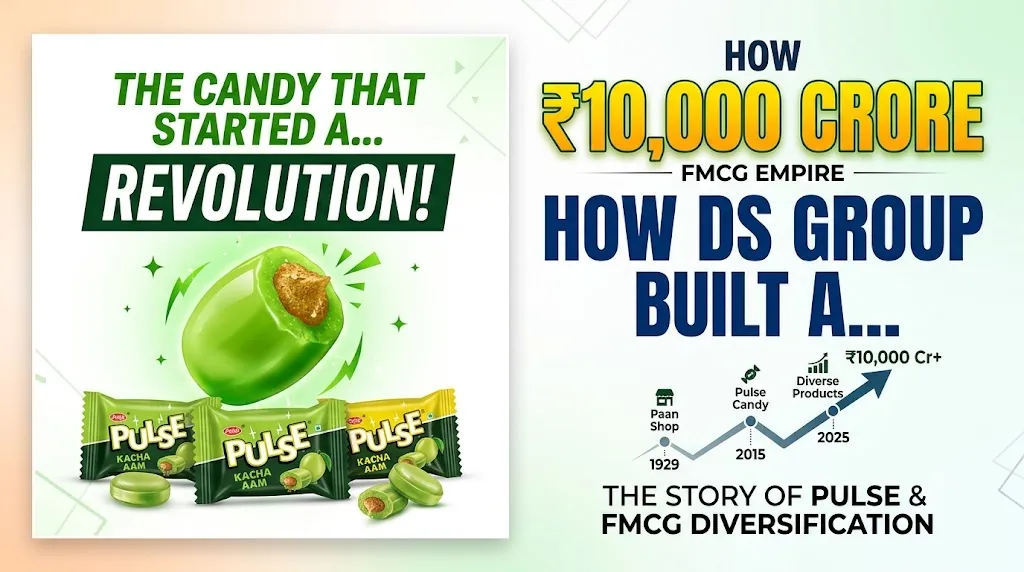
In 2015, DS Group launched Pulse Candy. The product entered a highly competitive candy market but stood out through its distinctive flavor and tangy center. Its growth was unusually fast for a ₹1 candy, and it achieved significant sales without relying heavily on traditional advertising.
By early 2016, Pulse had reportedly crossed ₹100 crore in sales, only around eight months after launch. By 2017, the brand had reached ₹326 crore in revenue and had become one of India’s leading candy brands.
Pulse demonstrated something important about the modern FMCG market: a low-priced product can still build a powerful brand if it offers a clear difference that consumers remember.
From 2018 to 2021, DS Group continued expanding its portfolio with products and brands including Tulsi, Royal Khajur Plus, Baba Black Supari, Only spices and Pulse Nutkarre.
By 2025, the transformation had become much clearer. DS Group had crossed ₹10,000 crore in revenue, with Food and Beverages contributing around 42%, Mouth Fresheners around 38% and Hospitality around 3%. Tobacco, which had once been the company’s dominant business, had fallen to around 10%.
That change is perhaps the most important part of the entire DS Group story.
The company did not simply add new products while keeping its old business unchanged. It gradually changed the structure of its business. A company once strongly associated with tobacco and paan-related products developed into a diversified FMCG group with a large portfolio of consumer brands.
Distribution played a major role in making this possible. Today, DS Group’s reported distribution network includes around 150 super stockists, more than 5,000 distributors and around 1.5 million retail outlets. For an FMCG company, this physical reach can be as important as advertising because even a strong product cannot generate large sales if consumers cannot easily find it.
This is also where DS Group’s business strategy becomes relevant to the wider creator economy and brand-building industry. The company demonstrates that brand value is not created by marketing alone. Product differentiation, distribution, pricing, consistency and consumer trust all work together.
For consumers, the lesson is equally practical. A product becoming popular does not necessarily mean its success happened overnight. Behind a successful FMCG brand can be years of supply-chain development, product testing, retailer relationships and market expansion.
For businesses, the larger lesson is diversification. DS Group’s shift away from heavy dependence on tobacco shows how a company can respond when regulation, consumer awareness and market conditions begin changing. Instead of waiting for the old business model to become unviable, the company built alternative revenue streams.
For brand value, the transformation also reduced the company’s dependence on a single category identity. Brands such as Catch and Pulse allowed DS Group to build stronger connections with everyday FMCG consumption, while its existing mouth-freshener business continued to remain an important part of the portfolio.
As observed in the latest available business and digital updates, DS Group’s evolution is a strong example of how long-term business strategy can matter more than short-term visibility. The company has often operated without the same level of public attention enjoyed by many consumer brands, yet its distribution network and product portfolio have created substantial market presence.
The phrase “Silent Giant” therefore captures an important part of the company’s positioning. Its growth has largely been driven by products, retail reach and category expansion rather than constant public attention.
The DS Group journey ultimately shows that successful transformation is rarely about abandoning the past overnight. It is about identifying where the market is moving and building enough new strength before the old model becomes a serious limitation. From a small Chandni Chowk shop to a diversified ₹10,000 crore FMCG business, the company’s story is fundamentally one of product innovation, distribution strength, brand building and long-term business strategy.
SOURCE: nighticonsulting
Note: Revenue figures, product milestones and historical claims should be checked against DS Group’s latest official disclosures and company records before publication. While we strive for accuracy, readers should refer to official company releases for the latest financial and business details.