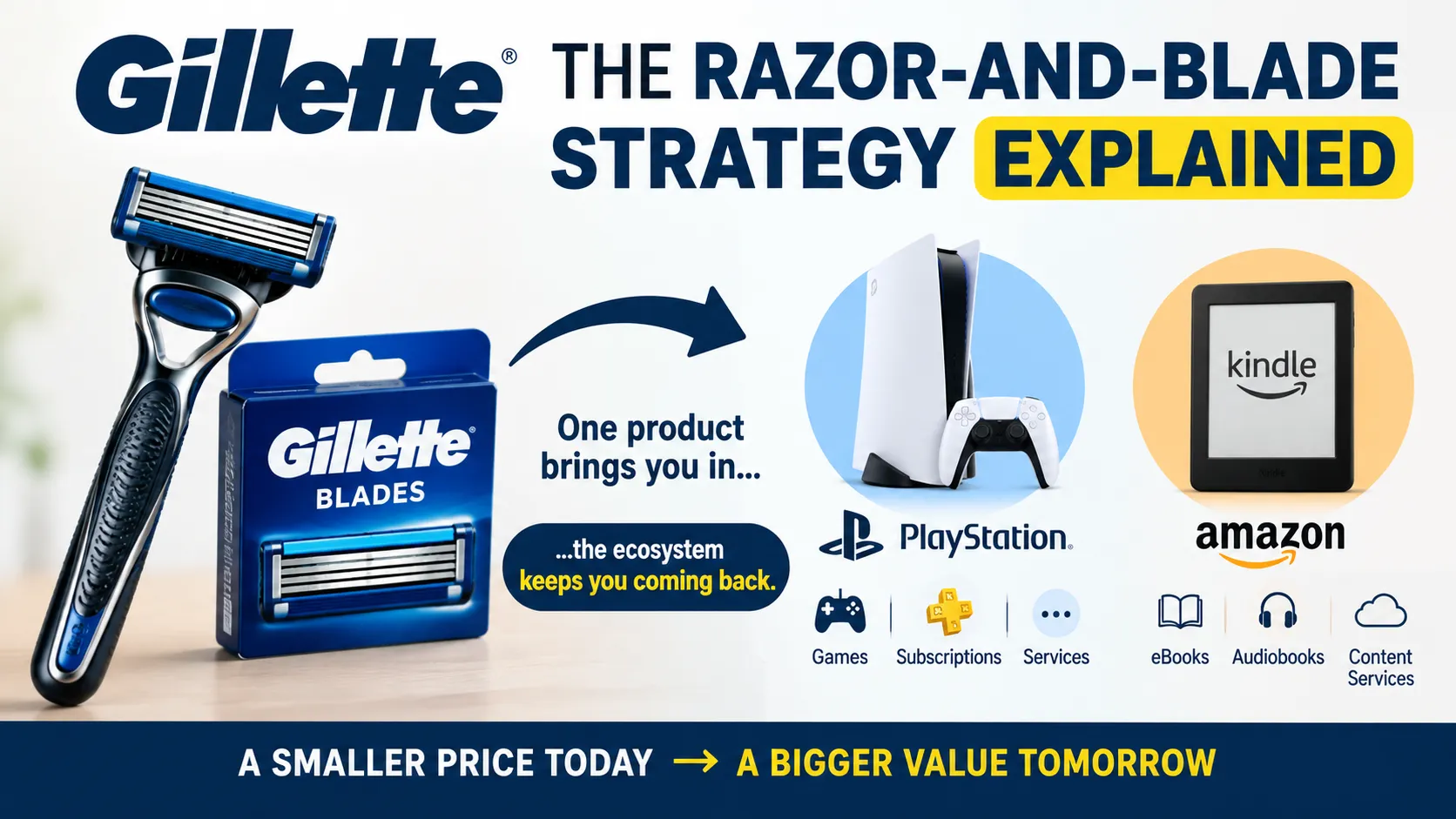
Gillette is more than a century-old grooming brand. Its business history also offers one of the clearest lessons in pricing, customer retention and ecosystem strategy. The company’s most important contribution was not simply the modern safety razor, but a business idea that changed how companies could make money from a customer over time.
King C. Gillette introduced a safety razor with a disposable blade concept in the early 1900s, helping make shaving easier at home. Gillette’s own historical account places a major breakthrough in 1901, when the company’s early safety razor technology brought disposable blades into American homes.
The real business lesson became clearer decades later. When Gillette faced stronger competition and changing market conditions, it increasingly focused on a simple economic principle: make the main product easier to buy and build recurring revenue from the products customers need afterward. This became widely known as the Razor-and-Blade model.
However, the popular version of this story is often oversimplified. Historical records show that Gillette did not simply give away razors and make all its money from expensive blades. A University of Chicago Law Review analysis of Gillette’s historical sales records shows that in 1921 the company sold more than 4.2 million razor sets, compared with about 2.1 million in 1920. It also reduced prices on some older razor products to reach customers who could not afford its more expensive models.
That distinction matters because the real strategy was broader than “sell cheap razors, sell expensive blades.” Gillette was lowering the entry barrier for customers while creating a product relationship that could generate repeat purchases. Once someone owned the razor, buying compatible blades became the natural next step.
This is the foundation of the modern Razor-and-Blade business model: one product brings the customer into the ecosystem, while related products, consumables, content or services generate revenue repeatedly.
The same economic logic can be seen far beyond personal grooming. Gaming consoles are a strong modern example. When Sony launched the PlayStation 4, reports at the time said the company expected to sell the hardware below its manufacturing cost and recover the economics through game purchases and PlayStation Plus subscriptions. Contemporary reporting cited an estimated loss of around $60 per console, although Sony executives did not publicly confirm that exact figure.
The important point is not the exact $60 figure. It is the structure of the business. Sony could view the console as a customer-acquisition product rather than the entire source of profit. Once a consumer entered the PlayStation ecosystem, games, subscriptions and other services created additional opportunities for revenue.
A similar principle appeared in Amazon’s Kindle strategy. In 2012, Amazon CEO Jeff Bezos confirmed that the company sold Kindle hardware at cost. The purpose was not simply to make money from the device itself, but to put the customer closer to Amazon’s digital content business.
This shows why the strategy became important to the wider creator economy, technology industry and digital business world. The product being sold cheaply does not necessarily have to be the product that generates the highest profit. Sometimes its bigger value is that it creates access to a customer who can generate revenue repeatedly.
But there is an equally important warning for startups: an ecosystem is only valuable when customers have a strong reason to stay.
Kodak is one of the clearest examples of what can happen when a successful business model becomes too closely tied to an old source of revenue. Kodak had developed a digital camera prototype as early as 1975, yet the company struggled to move away from the economics of traditional film. Research published in Business History Review notes that Kodak’s digital camera business eventually became significant, but digital cameras did not overtake film cameras in sales until 2002.
The lesson is not that the Razor-and-Blade model itself caused Kodak’s decline. The deeper problem was failing to adapt the business as technology changed. A profitable recurring-revenue system can become a weakness if management starts protecting the existing revenue stream instead of preparing for the next market.
For startups, this makes pricing a Business Strategy decision rather than simply a sales decision. A company can reduce the price of its entry product if that product creates a clear path toward higher-value purchases later. Software companies can use a similar structure with free or low-cost entry plans followed by paid features. Hardware companies can connect devices to subscriptions. Content businesses can use low-cost products to build a larger paying audience.
The key question is always the same: What is the customer’s next purchase after the first one?
If a startup spends heavily to acquire customers but has no strong second transaction, selling the first product at a low margin can quickly become dangerous. The business needs a clear customer lifetime value model. The money made from future purchases must justify the cost of acquiring and retaining the customer.
This is also where customer retention becomes more important than simply increasing sales volume. A strong ecosystem can increase switching costs because customers become familiar with a particular platform, product range or service. That can strengthen Brand Value and Social Media Influence, especially when customers actively recommend the ecosystem to others.
But businesses must also avoid making customers feel trapped. If prices rise too aggressively after the initial purchase, competitors can create an opportunity by offering a cheaper alternative. The modern market has shown that customers can switch when the perceived value of staying in an ecosystem falls.
For entrepreneurs, perhaps the most useful lesson from Gillette is therefore not “sell the first product cheaply.” It is design the entire customer journey before deciding the price of the first product.
A startup should understand how much it can afford to spend to acquire one customer, how often that customer is likely to purchase again, what the average lifetime value could be, and what would make the customer remain inside the ecosystem. Without those numbers, a low-price strategy can quickly turn into a cash-flow problem.
The model also has implications for Brand Endorsements and creator-led businesses. A creator, for example, may offer low-cost or free content to build an audience and later generate revenue through memberships, digital products, courses, services or brand partnerships. The same principle applies: the initial offering builds the relationship, while the wider ecosystem creates monetization opportunities.
What made Gillette’s strategy so influential was this shift in thinking. Instead of asking only, “How much profit can we make from this product?”, companies could ask, “How much long-term value can this customer create after entering our ecosystem?”
That is a much bigger business question.
More than a century after Gillette’s early innovations, the Razor-and-Blade model remains relevant because modern businesses increasingly compete around ecosystems rather than individual products. PlayStation connects hardware with games and subscriptions, while Kindle connects hardware with digital content. Historical evidence supports the broader principle, even though the exact economics and pricing structures differ from company to company.
The biggest takeaway for entrepreneurs is simple: a low-margin product can make sense when it creates a profitable long-term customer relationship. But the model only works when the ecosystem provides real value and the company continues to adapt as technology and customer behavior change.
Gillette’s lasting business lesson, therefore, is not really about razors or blades. It is about understanding where the money is made across the entire customer journey—and building a Business Strategy around that journey rather than around a single sale.
SOURCE: Independent monitoring and analysis of publicly available business history and industry sources.
Note: Historical business figures and company pricing strategies can vary by product, market and reporting period. Readers should refer to original company records and official disclosures for exact financial figures.